Affiliate disclosure: PicksLab earns commissions on qualifying Amazon purchases via the pickslab-20 tag, at no extra cost to you.
TL;DR - Our top pick: COSORI CP267-FD offers the best balance of six stainless steel trays, rear-fan airflow, a 48-hour timer, and controls broad enough for herbs, fruit, vegetables, and jerky preparation.
| Pick | Best For | Airflow and Tray Setup |
|---|---|---|
| COSORI CP267-FD | Best overall | Rear-mounted fan; 6 stainless steel trays |
| Hamilton Beach 32100 | Occasional batches and tighter budgets | Continuous airflow; 5 stackable trays |
| Septree 10-Tray 1000W | Large garden harvests | Rear-mounted fan; 10 stainless steel trays |
| Cercker 12-Tray 800W | Maximum tray count for the money | Dual-row rear fan; 12 stainless steel trays |
| Tribest Sedona Express | Premium control and a long warranty | Central fan; 11 stainless steel trays plus closed tray |
How We Chose the Best Food Dehydrators
The best food dehydrator is the one that matches the size and type of each batch. Herbs need stable low-temperature control, a basket of sliced apples needs usable tray area, and jerky adds a food-safety process that no maximum-temperature claim replaces. We compared airflow layout, tray count and material, temperature range, timer, accessories, cleanup, cabinet size, and warranty rather than ranking by wattage alone.
This is an expert-researched comparison, not a hands-on test. We checked the manufacturers’ current specifications and manuals, then used ten Brave Search API calls to verify the exact US Amazon listings. Every pick had visible new-item Add to Cart and Buy Now controls on September 3, 2026. An Elite Gourmet candidate was removed because its listing was currently unavailable, and several familiar models were excluded when Brave did not return a verifiable direct product listing.
An air fryer’s dehydrate mode can handle a small snack batch, but its basket area is limited. Our air fryer comparison covers that multipurpose route. If the work starts with several pounds of apples, carrots, or other produce, a food processor sized for holiday and batch prep can make the slicing stage substantially easier. For homemade jerky, pair the dehydrator with a dependable instant-read thermometer and follow the USDA process described below. Low-acid vegetables intended for shelf-stable jars need a different method; compare our pressure canners for home canning before planning that work.
Feature Comparison
| Product | Temperature Range | Timer | Published Power | Capacity and Cleanup |
|---|---|---|---|---|
| COSORI CP267-FD | 95-165 F | Up to 48 hr | 600W | 6 stainless trays; fruit-roll sheet and mesh screen included |
| Hamilton Beach 32100 | 100-160 F | Up to 48 hr | 500W | 5 stackable trays; fine-mesh and solid sheets included |
| Septree 10-Tray 1000W | 104-194 F | Up to 24 hr | 1,000W | 10 dishwasher-safe 304 stainless trays; removable drip tray |
| Cercker 12-Tray 800W | 70-190 F | Up to 24 hr | 800W | 12 dishwasher-safe stainless trays; 10.9 sq. ft. published area |
| Tribest Sedona Express | 77-167 F | Up to 99 hr continuous | 470W | 9.9 sq. ft.; reusable filter and closed debris tray |
1. COSORI CP267-FD
Buy COSORI CP267-FD on Amazon ->
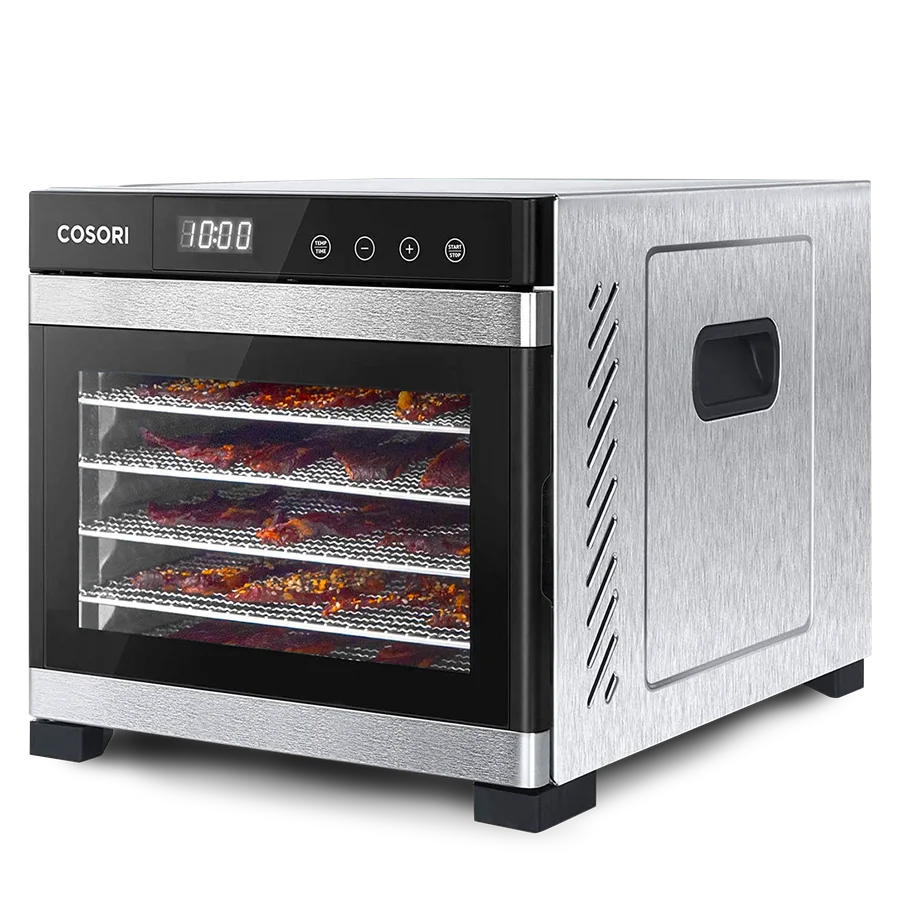
Manufacturer image: COSORI.
Key specs: Trays: 6 stainless steel; Temperature range: 95-165 F; Timer: 30 minutes to 48 hours; Power: 600W; Dimensions: 13.4 x 17.8 x 12.4 in.
The COSORI CP267-FD is the best all-around choice because its six-rack cabinet is large enough for useful harvest batches without becoming a floor-standing appliance. A rear-mounted fan sends heated air across the trays, so it avoids the tray-stacking and rotation questions that come with simpler base-fan designs. COSORI also publishes an operating-noise figure below 48 dB, useful for a process that may run most of a day.
The digital controls cover low herb temperatures through the range commonly used for fruit, vegetables, and meat drying. The package includes a mesh screen for small ingredients and a fruit-roll sheet, so buyers can start with more than sliced produce without immediately ordering liners.
Six trays are still a medium batch. Gardeners processing several baskets at once will finish sooner with the Septree or Cercker, while occasional users may not need to spend beyond the Hamilton Beach. Choose the COSORI for balanced capacity and straightforward rear airflow, not maximum volume.
2. Hamilton Beach 32100
Buy Hamilton Beach 32100 on Amazon ->
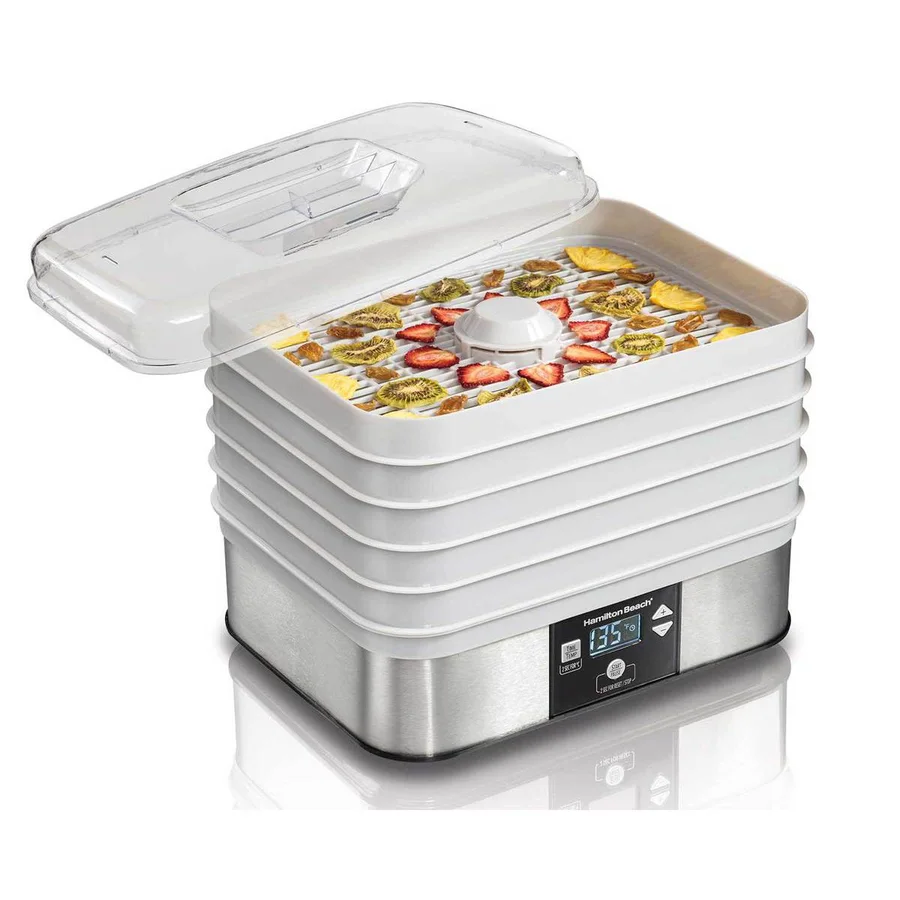
Manufacturer image: Hamilton Beach.
Key specs: Trays: 5 stackable; Temperature range: 100-160 F; Timer: up to 48 hours; Power: 500W; Included sheets: 1 fine mesh and 1 solid fruit-roll sheet.
The Hamilton Beach 32100 is the sensible entry point for occasional fruit, herb, and snack batches. Its five trays stack over a compact powered base, and the clear lid makes it easy to check progress without dismantling the stack. Digital time and temperature controls are a meaningful upgrade over fixed-temperature budget dehydrators.
Hamilton Beach includes both a fine-mesh sheet for herbs and a solid sheet for fruit leather. That makes the package more useful on day one than a bare set of wide-grid trays. The 100 F minimum is adequate for many produce projects, though it does not reach as low as the COSORI, Cercker, or Tribest.
The stackable layout is the compromise. Cabinet models give every rack a more direct path to a rear or central fan and are easier to load one tray at a time. Buy the Hamilton Beach when storage, simple batches, and lower initial cost matter most. Skip it when fall harvest means repeated full loads rather than a few apples or herbs.
3. Septree 10-Tray 1000W
Buy Septree 10-Tray 1000W on Amazon ->
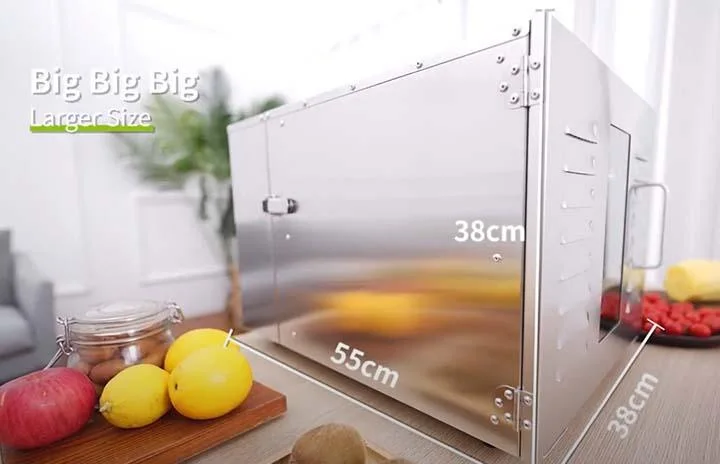
Manufacturer image: Septree.
Key specs: Trays: 10 food-grade 304 stainless steel; Temperature range: 104-194 F; Timer: up to 24 hours; Power: 1,000W; Published noise: 45-50 dB.
The Septree 10-Tray is the harvest-volume pick. Its rear fan and horizontal airflow serve ten removable stainless racks without requiring food to be stacked directly above a bottom heating element. Septree publishes 17 square feet of drying area for this version, enough to make its footprint worthwhile for gardeners, hunters, or households processing several ingredients in one session.
Its 194 F ceiling is the highest in this group, but that number should not be treated as a shortcut around safe meat preparation. The practical advantage is range: the machine can cover lower produce settings and higher-temperature recipe stages, with automatic shutoff when the 24-hour timer ends. The stainless trays and drip tray are dishwasher-safe according to Septree.
This is a large 1,000W cabinet, so it is a poor match for a small apartment counter or a household drying one banana bunch at a time. Choose it when tray area will be filled regularly. Otherwise, the COSORI delivers a more manageable all-purpose format.
4. Cercker 12-Tray 800W
Buy Cercker 12-Tray 800W on Amazon ->
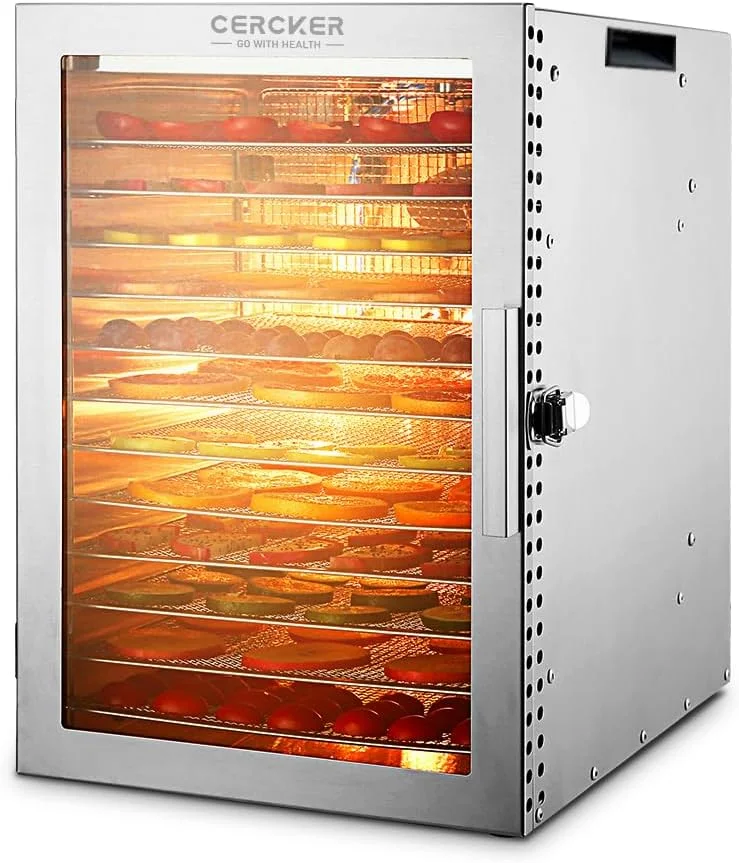
Manufacturer image: Cercker.
Key specs: Trays: 12 stainless steel; Published drying area: 10.9 sq. ft.; Temperature range: 70-190 F in 5 F steps; Timer: up to 24 hours in 30-minute steps; Power: 800W.
The Cercker offers the most rack positions here and is the strongest capacity-per-dollar alternative to the premium Tribest. A dual-row rear fan moves air horizontally through the cabinet, while the glass door and rear light help with visual checks. The 70 F minimum is also unusually low, though buyers should always follow the recipe and food-safety source for the ingredient rather than selecting a temperature because the control permits it.
Cercker includes a drip tray, silicone gloves, recipe book, and manual. The company specifies dishwasher-safe 11.5-inch trays, overheat protection, noise at or below 50 dB, and a three-year warranty. Those are useful ownership details for a machine intended to run long batches.
Brand support is the tradeoff. COSORI, Hamilton Beach, and Tribest have more established appliance support footprints, while Cercker’s appeal is a large feature set at a lower tier than most 12-tray cabinets. Buy it for regularly filled racks and broad temperature control. Skip it if long-term parts availability matters more than tray count.
5. Tribest Sedona Express SDE-S6780-B
Buy Tribest Sedona Express on Amazon ->
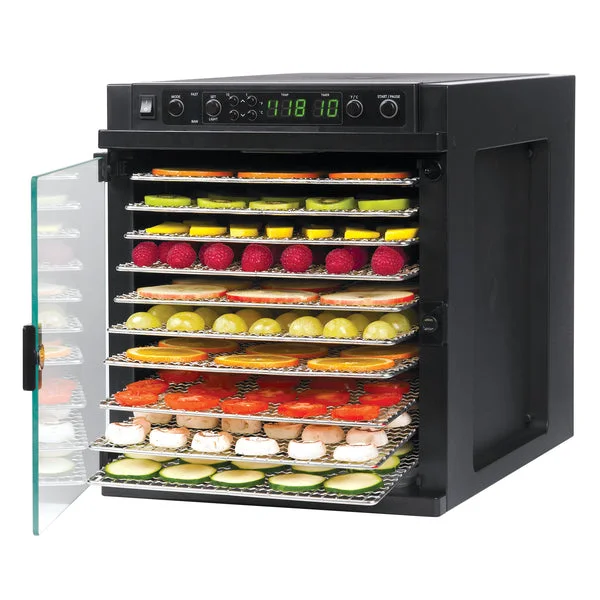
Manufacturer image: Tribest.
Key specs: Trays: 11 stainless steel plus 1 closed tray; Drying capacity: 9.9 sq. ft.; Temperature range: 77-167 F; Power: 470W; Warranty: 10 years for household use.
The Tribest Sedona Express is the premium control pick. Its Two-Stage Sequential Temperature-Timer can begin a program at one temperature and automatically finish at another, which removes a manual setting change from recipes that call for staged drying. Fast, Raw, and Combo modes provide more process control than the basic temperature-and-clock panels on the other four machines.
The cabinet is only 12 inches wide but holds 11 stainless racks and 9.9 square feet of published drying area. A central fan, internal light, reusable air filter, and side-hinged glass door make it easier to monitor and maintain than a stack-style machine. Tribest also specifies up to 99 hours of continuous operation and a ten-year household warranty.
The price is difficult to justify for simple apple chips or occasional herbs. Its value comes from compact rack density, staged programming, and warranty length, not more raw area than every cheaper cabinet. Choose it for frequent, controlled batches. Most households should buy the COSORI and keep the substantial difference in their food budget.
How Much Dehydrator Capacity Do You Need?
Tray count is only a shortcut because tray dimensions vary. The National Center for Home Food Preservation estimates that 12 square feet of drying space handles about half a bushel of produce. The Cercker and Tribest publish roughly 10 square feet, while Septree publishes 17 square feet for its 10-tray version. COSORI and Hamilton Beach make more sense when you expect smaller, more frequent loads.
Airflow changes the loading experience. Rear- and central-fan cabinets expose each rack to a direct horizontal path and let you remove one tray without unstacking the rest. Stackable machines save space and money but can require more attention to tray arrangement. In either format, leave the spacing required by the manual and avoid overlapping pieces simply to fill every rack.
Jerky and Dried-Food Safety
A dehydrator’s set temperature is not proof that the center of meat reached a safe temperature. USDA Food Safety and Inspection Service guidance recommends heating meat to 160 F and poultry to 165 F before dehydrating, then maintaining 130-140 F during drying. Use a food thermometer and the complete USDA process rather than relying on the dehydrator display alone.
Cool dried foods completely before packing them. The National Center for Home Food Preservation storage guidance recommends clean, dry, moisture-resistant containers and a cool, dry, dark storage location. If condensation appears, the food needs attention; moldy food should be discarded rather than redried.
Who Should Buy What
- For the best balance of capacity and countertop size: choose the COSORI CP267-FD.
- For occasional batches and a lower-cost start: choose the Hamilton Beach 32100.
- For large garden harvests: choose the Septree 10-Tray.
- For twelve racks without Tribest pricing: choose the Cercker 12-Tray.
- For staged temperature programs and a ten-year warranty: choose the Tribest Sedona Express.
FAQ
Is a rear-fan food dehydrator better than a stackable model?
A rear-fan cabinet sends air horizontally across separate racks and makes each tray independently accessible. A stackable model is usually smaller and less expensive, but the airflow path and tray order can require more attention. Neither format fixes overloaded trays or inconsistent slice thickness.
Can I safely make jerky by setting a dehydrator to 165 F?
Do not rely on the set point alone. USDA guidance recommends heating meat to 160 F and poultry to 165 F before dehydrating because evaporative cooling can prevent the food itself from reaching the displayed air temperature soon enough. Follow the full USDA jerky method and verify food temperature with a thermometer.
Are stainless steel trays better than plastic trays?
Stainless steel racks tolerate repeated loading without absorbing colors or odors and are common in cabinet-style machines. Plastic stackable trays can make a dehydrator lighter and easier to store. Cleaning instructions still vary by model, so dishwasher safety should be confirmed rather than assumed from the material.
How many trays do I need for a garden harvest?
Use drying area rather than tray count when manufacturers publish it. NCHFP’s rough planning figure is 12 square feet for about half a bushel of produce. A five- or six-tray machine suits smaller recurring batches, while a 10- or 12-tray cabinet is easier to justify when several baskets need processing at once.
Can I dry herbs and jerky in the same batch?
It is usually better to separate foods that require different temperatures, preparation rules, or carry strong aromas. Herbs and raw meat are a particularly poor pairing because safe jerky preparation has distinct handling and heating requirements. Use the manual and a validated food-preservation source for each ingredient.
Bottom Line
For cooking meals rather than drying a harvest, our air-fryer basket and controls comparison covers single-basket machines under $150. A fryer’s Dehydrate setting does not provide the same multi-tray loading arrangement as these dedicated dryers.
Once food has been properly dried and cooled, packaging is the next decision. Our meal-prep vacuum sealer guide compares bag requirements and cleanup; vacuum packaging does not replace the drying process or make improperly preserved food shelf-stable.
The COSORI CP267-FD is the best food dehydrator for most fall-harvest kitchens because six stainless trays, rear airflow, a 95-165 F range, and a 48-hour timer cover the widest useful middle ground. Choose Hamilton Beach for occasional small batches, Septree or Cercker for bulk processing, and Tribest when staged controls and warranty support justify a premium machine.
This article contains affiliate links. PicksLab may earn a small commission at no extra cost to you. Our recommendations are based on the review method described in this article.