TL;DR: If you own no cordless tools, choose the mower or other main tool you need first, then compare its complete battery-and-charger kit with the next tool you expect to buy. Start with EGO 56V POWER+ for a shared yard-equipment platform; compare Ryobi ONE+, DeWalt, Milwaukee or Makita when you also want workshop tools. Greenworks and STIHL belong on the shortlist too, but choose a specific battery family rather than just a brand. Existing batteries are a useful tie-breaker, not a prerequisite.
The expensive mistake is buying a bare tool because its logo matches the battery on your shelf. The second mistake is buying a kit that works today but leaves the next essential tool on a different platform. This guide helps you check those two decisions before comparing discounts.
We reviewed US manufacturer compatibility pages, product documentation and warranty policies on September 13, 2026, and expanded the platform comparison on September 15. This is a researched platform guide, not a tested mower or blower ranking. We have not measured cross-brand cutting performance, noise, service responsiveness or lifetime ownership cost. Manufacturer links below are reference resources, not verified Amazon purchase recommendations.
Starting From Zero: Choose the Job Before the Battery
You do not need to buy a drill first or arrive with a collection of batteries. If mowing is the main job, compare mower kits first, including the supplied battery count, capacity and charger. Then check the matching trimmer or blower you would add. A cheap trimmer kit is not a useful saving if its battery configuration will not meet the mower’s requirements.
| What You Need | Systems Worth Comparing | What Decides the Purchase |
|---|---|---|
| A mower, trimmer and blower for the yard | EGO 56V, Ryobi 40V, or one Greenworks voltage family | Choose the mower that fits your job, then price the actual batteries and charger needed for the whole routine |
| Yard tools plus drills and saws for DIY | Ryobi ONE+, DeWalt 20V MAX/FLEXVOLT, Milwaukee M18, or Makita LXT | Confirm the exact yard tool uses the same packs; some tools require two packs or a different platform |
| An outdoor-focused system with a local service option | STIHL battery systems, alongside locally serviced alternatives | Compare the exact AK or AP-family tools and the service route available near you; the STIHL name alone does not establish shared batteries |
| Just one occasional trimming or cleanup job | A suitable standalone kit, corded tool or manual tool | Buy for that job rather than paying for an ecosystem you may never expand |
For a yard-only starting point, EGO’s common 56V battery family makes the compatibility comparison straightforward. That is a reason to shortlist it, not evidence that it cuts better or costs less than a particular Greenworks, Ryobi or STIHL kit. For workshop-and-yard use, start with the exact tool pair you need and compare ONE+, DeWalt, M18 and LXT on that pair instead.
Check the box contents before ordering: a bare tool normally requires a separately owned or purchased battery and charger. Also check whether the tool needs two batteries at once. One person mowing and then trimming has a different battery requirement from two people using separate tools simultaneously.
Already Own Batteries? Check Whether Reusing Them Helps
| Your Situation | Start Your Comparison Here | What Could Change the Decision |
|---|---|---|
| You own Ryobi 18V ONE+ tools | Ryobi 18V ONE+ yard tools | The particular tool or runtime you need may justify a separate system |
| You own Ryobi 40V packs | Ryobi 40V tools | ONE+ garage tools will not use those packs |
| You own Greenworks batteries | The same Greenworks voltage family | Check physical-fit exceptions and older equipment before adding a larger pack |
| You own a different brand’s tools | The platform checks below | Match the battery family and required pack count, not just the logo |
There is no evidence here that one brand is universally fastest, cheapest or most reliable. An existing compatible battery is a reason to investigate a tool, not a reason to accept the wrong cutting width, weight or handling.
Battery Compatibility: The Logo Is Not Enough
| Platform | What Can Share Batteries? | What Does Not Follow From That |
|---|---|---|
| Ryobi 18V ONE+ | Tools within the ONE+ 18V family | A 40V tool is not an upgrade that accepts your 18V pack |
| Ryobi 40V | Tools in Ryobi’s 40V family, subject to exact-model instructions | HP branding does not make it ONE+ or establish 18V compatibility |
| Greenworks 40V | Compatible tools within its 40V family | Neither Greenworks 60V nor 80V accepts that pack |
| Greenworks 60V | Compatible 60V tools, with documented pack-fit exceptions | Matching voltage does not guarantee every large pack fits every enclosure |
| Greenworks 80V | Compatible 80V tools; check older models | Neither another brand’s 80V label nor a different Greenworks voltage establishes compatibility |
| EGO 56V ARC Lithium | EGO specifies compatibility across POWER+ equipment and chargers | One small pack is not proof of sufficient runtime, or of meeting a tool’s required pack count |
| DeWalt 20V MAX / FLEXVOLT | FLEXVOLT batteries support compatible 20V MAX and 60V MAX tools | Do not assume an ordinary 20V MAX pack supplies a tool that requires FLEXVOLT |
| Milwaukee M18 | M18 batteries work within the M18 system | M12 and MX FUEL are separate systems; check the specific tool’s required battery configuration |
| Makita LXT | LXT 18V packs also power LXT 36V tools designated 18V X2, using two packs | XGT is a different battery family; an X2 tool needs two compatible batteries |
| Makita XGT | XGT 40V max packs also power XGT 80V max tools designated 40V max X2, using two packs | This does not make an LXT pack a direct replacement for an XGT pack |
| STIHL AK / AP families | Match the tool to its named family; STIHL documents ALLPRO compatibility with the AP lineup | AK and AP packs are not interchangeable; small AS-system tools are another separate family |
Check the Ryobi platform catalog, Greenworks compatibility FAQ and EGO battery documentation against the model numbers on your equipment. Do not modify connectors or assume an aftermarket adapter is manufacturer-approved.
Ryobi: Separate ONE+ From 40V Before Shopping
Platform facts: ONE+: 18V family spanning workshop and outdoor tools; 40V: separate battery family; HP: a technology designation used within named platforms, not a shared battery standard.
Choose ONE+ first when you already own its batteries and the available yard tool meets your needs. Ryobi’s ONE+ history and catalog show the shared platform extending across drills, saws, cleaning products and lawn tools. That garage-to-yard connection belongs to ONE+, not to every green Ryobi tool. When comparing cordless drill kits, note the included battery platform before treating it as a future yard-tool investment.
Compare the separate 40V range when its particular mower, trimmer or blower is the better fit. Both catalogs contain HP-branded tools. The letters do not make an 18V pack suitable for a 40V socket. Nor should you infer identical performance from two products carrying the HP label.
Can One Ryobi Charger Handle Both Families?
Yes, a specifically designed dual-platform charger can. Ryobi’s PCG007 has separate connections for 18V ONE+ and 40V batteries. This is an exception worth knowing if you already own both systems; it is not a feature to assume on the charger bundled with any random kit.
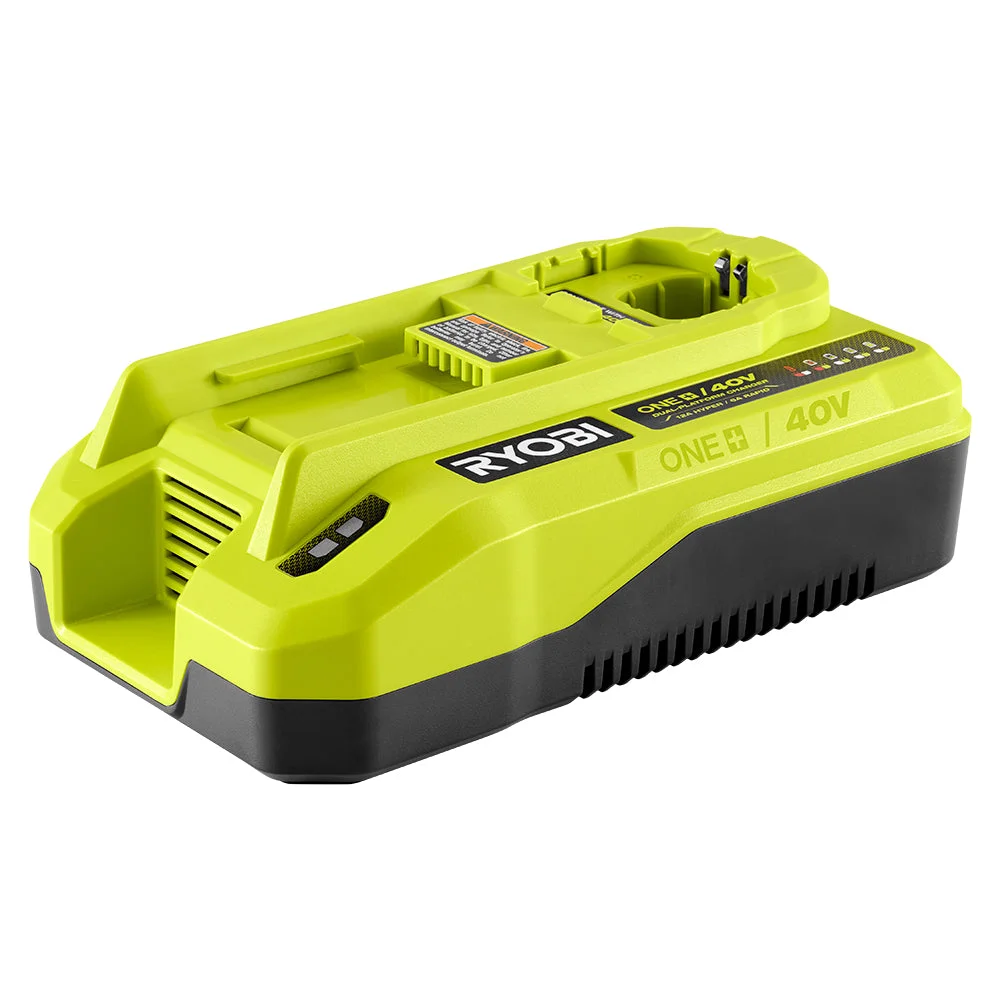 Image credit: Ryobi. Shown to illustrate charger compatibility, not as a ranked charger recommendation.
Example specifications: Model: PCG007; Supported platforms: Ryobi 18V ONE+ and 40V; Mounting: wall-mountable; Indicators: charge-status LEDs.
A dual charger reduces charger clutter, not the number of incompatible battery families. Your 18V pack still cannot power a 40V tool.
Greenworks: Choose a Voltage Family, Then Check Pack Fit
Platform facts: 40V, 60V and 80V are separate families; chargers are designated by voltage platform; some same-voltage tools have battery-size exceptions.
Choose a particular Greenworks voltage family when its present and next-needed tools make sense together. Moving from Greenworks 40V to 80V keeps the brand name but adds a different battery and charger system. Do not describe that move as reusing the original kit.
The manufacturer’s battery FAQ also documents a less obvious problem: its 60V 8.0Ah battery model 2957102 has height-related incompatibilities with listed dual-port mowers, pressure washers and the wet/dry vacuum. The same FAQ identifies specific older 80V snow throwers with small-pack restrictions. For those combinations, matching the voltage is only the first check.
That makes the actual battery model relevant when shopping a discounted replacement pack or used tool. Confirm the enclosure clearance and compatible-pack list with the manufacturer rather than extrapolating from the capacity label or a product photo.
EGO: A Simpler Shared Platform, Not a Runtime Guarantee
Platform facts: POWER+ ARC Lithium uses a 56V family; EGO documents shared POWER+ battery/charger compatibility; pack capacity and the tool’s required battery configuration still need checking.
EGO is a useful starting comparison for a new yard-tool collection because its ARC Lithium documentation establishes a common battery family across POWER+ equipment. That avoids choosing among the three Greenworks voltage families covered here.
However, a battery fitting the tool does not answer how long it will run on your job. Check the exact kit’s battery quantity and capacity, the manufacturer’s stated test conditions, and the required battery configuration in the tool manual. A mower, handheld trimmer and snow blower are different loads; this guide does not assign a universal yard-size limit from voltage.
Charging time also belongs to a specific pack/charger pairing. For example, EGO’s 8.0Ah ARC Lithium MAX battery documentation lists different charging times for its standard, rapid and turbo chargers. A spare pack and a faster charger solve different scheduling problems, so inspect what the kit includes before comparing prices.
Other Brands Worth Comparing
DeWalt: Check 20V MAX Versus FLEXVOLT
DeWalt is worth comparing when your planned collection includes both DIY tools and outdoor equipment. Its FLEXVOLT system uses batteries that switch between compatible 20V MAX and 60V MAX tools. That cross-platform feature belongs to FLEXVOLT packs, not every yellow battery.
For a first purchase, compare the exact outdoor tool kit and the next workshop tool together. A 60V MAX purchase needs the appropriate FLEXVOLT battery; do not budget on reusing an ordinary 20V MAX pack. This is a compatibility distinction, not a reason to assume the higher-voltage tool is necessary for your yard.
Milwaukee: M18 Can Connect the Workshop and Yard
Milwaukee’s outdoor equipment catalog includes M18 options alongside equipment from other Milwaukee systems. M18 can therefore make sense for someone planning both workshop and yard purchases, even without existing batteries.
Keep the system names separate: Milwaukee documents compatibility within each system, not across M12, M18 and MX FUEL. Check the particular mower or other tool’s battery configuration and kit contents before adding up a starter package. A shared brand does not eliminate that check.
Makita: LXT and XGT Are Different Decisions
Makita offers another workshop-and-yard route, but its battery compatibility FAQ distinguishes LXT from XGT. LXT uses 18V packs; LXT tools marked 36V (18V X2) use two of them. XGT uses 40V max packs, with XGT tools marked 80V max (40V max X2) requiring two.
The practical consequence for a new buyer is battery quantity as well as platform. A two-pack tool cannot be budgeted like a single-pack tool, and an LXT battery is not a direct substitute for an XGT battery. Choose the tool pair that suits your jobs before committing to either family.
STIHL: Match AK or AP, Then Check Local Support
STIHL’s battery-system overview gives buyers another outdoor-focused option, including its homeowner-oriented AK family and AP-compatible equipment. Its current overview also documents ALLPRO compatibility with the AP lineup. That does not mean all STIHL cordless products share batteries: the manufacturer’s AK/AP compatibility answer explicitly rules out swapping those two types.
Compare the actual tool, battery, charger and local service arrangement with the other shortlisted kits. Do not pay for professional-positioned equipment simply because its label sounds stronger, and do not assume a nearby seller will service every model. No US Amazon availability is established for STIHL tools in this guide.
The Next-Tool Test
Before committing to a starter kit, write down today’s tool and the next tool you realistically expect to buy. Then check these five items for both:
- Exact platform and model. Record the tool, battery and charger model numbers, not just the brand.
- Battery inclusion. Separate a bare tool from a kit, and check the supplied pack count and capacity.
- Compatibility and fit. Confirm required pack count, allowed batteries and any enclosure restrictions.
- Your work sequence. Decide whether you will mow and then trim, or have two people working simultaneously. One shared battery cannot power two separate tools at once.
- Service and consumables. Locate the correct blade, trimmer head or other wear part, and check the service route before buying.
Here is how that changes real shopping decisions:
- Existing ONE+ drill owner adding a hedge trimmer: check the 18V ONE+ options first. A discounted 40V trimmer is still a new-system purchase.
- Greenworks 60V owner adding a large spare: check the pack model against enclosure restrictions before assuming the higher Ah number is an uncomplicated upgrade.
- New mower owner planning a blower next: compare both complete setups, including the battery and charger needed to finish your own routine, rather than selecting the cheapest first tool.
For leaf collection rather than simply moving leaves, our leaf vacuum and mulcher guide covers a different tool-selection question. Battery compatibility cannot turn a blower into a vacuum.
Warranty: Read the Policy for the Exact Item
Do not rank warranty support by a single brand-wide number. Coverage duration, registration conditions, permitted use and seller eligibility can differ between a tool and its included battery. These are the three policies reviewed in the original comparison, not a seven-brand warranty ranking; check the supplied terms for any DeWalt, Milwaukee, Makita or STIHL kit you shortlist.
| Brand | What to Verify Before Buying | Current Manufacturer Reference |
|---|---|---|
| EGO | Product category, original authorized seller, battery-model registration conditions and service transport | US warranty policy |
| Greenworks | Standard versus Pro versus Renewed terms, registration and proof of purchase | US warranty policy |
| Ryobi | The tool’s category and separate battery/charger terms, rather than borrowing a number from another platform | Warranty lookup |
For example, EGO’s policy distinguishes ordinary ARC Lithium batteries from ARC Lithium MAX and lists model-specific registration extensions. It also states that buyers transport equipment to and from the authorized service center at their expense. Greenworks separates standard, Pro and Renewed coverage and requires proof of purchase and registration. Those are concrete checks; none establishes that one brand resolves claims faster.
FAQ
What should I buy if I do not own any batteries yet?
Start with a complete kit for your main job, often the mower, and confirm that batteries and a charger are included. Check its required pack count and the tool you expect to add next. EGO, a selected Greenworks family, Ryobi 40V and STIHL are outdoor-focused starting comparisons; ONE+, DeWalt, M18 and Makita LXT also merit comparison for a mixed workshop-and-yard collection. Choose by the exact tools you need, not by a requirement to own batteries first.
Can I use a Ryobi 18V battery in a 40V tool?
No. ONE+ 18V and Ryobi 40V are different battery platforms. A designated dual-platform charger may charge each type through its appropriate connection, but it does not convert one battery into the other or make the tools interchangeable.
Are all Greenworks batteries with the same voltage interchangeable?
Greenworks generally describes compatibility within a voltage family, but its FAQ lists exceptions involving older equipment and pack height. Check the exact battery model and tool, especially when adding a larger-capacity pack or buying older used equipment. A same-voltage label alone does not resolve those exceptions.
Does higher voltage mean a better lawn tool?
Not by itself. Voltage is one system specification, not a measured result for cutting, handling or useful runtime. Compare the exact tool’s job, supplied battery configuration and documented operating conditions. This guide has no controlled performance evidence that would justify ranking every 80V tool above every 40V or 56V tool.
Should I buy a bare tool or another kit?
A bare tool makes sense when you already own compatible batteries and a charger that meet its requirements. Compare another kit when you need additional capacity or want someone else to work at the same time. Check the contents model by model; do not count an incompatible spare as a saving.
Bottom Line
Starting from nothing is a normal buying situation. Compare a complete kit for the main job plus the next tool, not a bare-tool discount you cannot use yet. EGO, Ryobi 40V, a selected Greenworks family and STIHL offer outdoor-focused starting comparisons. Ryobi ONE+, DeWalt, Milwaukee M18 and Makita LXT deserve consideration when workshop tools are part of the plan too; keep their voltage families and battery-count requirements straight.
If you already own compatible batteries, reuse them when the actual tool is right for the job. In either case, the best first purchase leaves a sensible second purchase. Check the next tool, the actual pack and the charger together before committing.
This guide links to manufacturer documentation and related PicksLab buying guides. PicksLab may earn commissions through affiliate links elsewhere on the site. The comparisons here are based on the researched method described above.